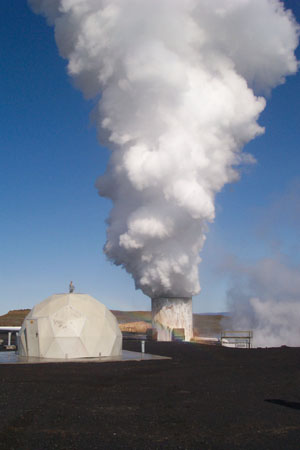
Iceland (Ísland) sits astride the Mid-Atlantic Ridge (Mið-Atlantshafshryggurinn), where the North American and Eurasian tectonic plates slowly pull apart. This unique geological position makes the island one of the most volcanically active places on Earth, with more than 200 volcanoes and over 600 hot springs. The same forces that create spectacular landscapes also supply abundant heat from deep underground, known as geothermal energy (jarðvarmi).
For centuries Icelanders used hot springs for bathing and laundry. In the 20th century the country systematically developed these resources. Today geothermal energy supplies roughly 65 percent of Iceland’s primary energy needs and heats more than 90 percent of buildings through extensive district heating networks (hitaveita). Combined with hydropower, renewable sources cover about 85 percent of primary energy, while nearly all electricity (over 99 percent) comes from hydro and geothermal plants.
Hot water and steam are extracted from underground reservoirs through boreholes, often drilled 1–2 kilometres deep (and in research projects much deeper). At power stations the steam drives turbines that generate electricity. Many plants are cogeneration facilities that also supply hot water for district heating, greenhouses, swimming pools, and industry. After use, the water is often reinjected to maintain reservoir pressure and reduce environmental impact.
As of 2025, Iceland operates nine geothermal power plants larger than 0.5 MW with a combined installed capacity of approximately 785 MW. The largest is Hellisheiði Power Station (Hellisheiðarvirkjun) at 303 MW, followed by Nesjavellir (120 MW), Reykjanes (100 MW), Þeistareykir (90 MW), Svartsengi (about 76 MW), and Krafla (60 MW). These stations produce roughly 30 percent of the country’s electricity; the rest comes mainly from hydroelectric dams.
Beyond electricity and space heating, geothermal resources support greenhouses that grow tomatoes and cucumbers year-round, fish farms, and the melting of snow on streets and pavements in towns. Public swimming pools heated by geothermal water are a central part of Icelandic social life in every community.
The most famous tourist attraction linked to geothermal activity is the Blue Lagoon (Bláa lónið). Its milky-blue water is actually effluent from the nearby Svartsengi power plant. After driving turbines, the mineral-rich seawater (high in silica) is released into a lava field, creating the lagoon. The silica gives the water its distinctive colour and softens the skin; the temperature stays around 37–39 °C year-round. Similar natural or semi-natural hot pools exist across the country, including at Mývatn in the north and in the town of Hveragerði, known as the “Flower Town” for its geothermal greenhouses.
Visitor centres at major power stations such as Hellisheiði allow the public to learn about the technology. According to Visit Iceland, these sites form part of a broader story of how renewable energy transformed the country from a coal-dependent society in the early 20th century into one with high living standards and low energy-related emissions.
The rapid growth of artificial intelligence and large data centres has created enormous demand for reliable, 24-hour electricity. Geothermal power is particularly well suited to this need because plants can run continuously with capacity factors often above 85–90 percent, unlike solar or wind which vary with weather. The heat can also be used for cooling data centres through absorption chillers or other thermal systems.
In recent years technology companies have signed power-purchase agreements with geothermal developers. Projects using enhanced geothermal systems (EGS), which create artificial reservoirs by fracturing hot dry rock, are expanding the resource beyond traditional volcanic areas. While Iceland already has abundant conventional geothermal resources and a fully renewable electricity grid, the same technologies being developed for data centres elsewhere demonstrate the broader global relevance of the experience gained in Iceland over decades of operation.
Iceland’s experience with deeper and hotter resources continues through the Iceland Deep Drilling Project (IDDP, Íslenska djúpborunarverkefnið). Launched in 2000 by energy companies and the National Energy Authority, the project aims to reach supercritical fluids at temperatures above 400 °C and depths greater than 4 km. The first well, IDDP-1 at Krafla, unexpectedly encountered magma at about 2.1 km and produced superheated steam above 450 °C, demonstrating the extreme energy potential near magma. The second well, IDDP-2 at Reykjanes, reached 4,659 metres with temperatures around 427 °C and successfully accessed supercritical conditions. These experiments help improve the economics of geothermal production worldwide.
Environmental management has also advanced. At Hellisheiði, the Carbfix project dissolves carbon dioxide (and hydrogen sulphide) in water and injects the mixture into basaltic rock. The gas mineralises into solid carbonates within about two years, far faster than natural processes. This technique has stored more than 100,000 tonnes of CO₂ and is considered a model for reducing emissions from geothermal plants and, potentially, from other sources.
Related images (Wikipedia / Wikimedia Commons):